ACD-301 Reliable Study Guide, ACD-301 Exam Testking
Wiki Article
P.S. Free & New ACD-301 dumps are available on Google Drive shared by DumpsActual: https://drive.google.com/open?id=1S7Vlz9zHyXcjX-tW_qB2xBtIKhdCdEhb
ACD-301 exam practice is well known for its quality service! Our users are all over the world, and we use uniform service standards everywhere. Our after-sales service staff will be on-line service 24 hours a day, 7 days a week. So, whether you are purchasing ACD-301 Training Materials, or during the study period, no matter what kind of problems you encounter on the ACD-301 study guide, you can always contact online customer service to get the timely help.
Our DumpsActual provides ACD-301 braindumps and training materials in PDF and software, which contains ACD-301 exam dumps and answers. Moreover, the content of ACD-301 braindumps and training materials covers largely and more reliably, and it will help you most to prepare ACD-301 test. If you fail the ACD-301 certification exam with our ACD-301 dumps, please don't worry. We will refund fully.
>> ACD-301 Reliable Study Guide <<
ACD-301 Exam Testking | Latest Real ACD-301 Exam
On our webiste, you have easy access to our free demos of our ACD-301 exam braindumps. Once you apply for our free trials of the ACD-301 study materials, our system will quickly send it via email. Last but not least, you are available for our free updated version of the ACD-301 Real Exam. Whenever you have problems about our study materials, you can contact our online workers via email. We warmly welcome you to experience our considerate service.
Appian Certified Lead Developer Sample Questions (Q25-Q30):
NEW QUESTION # 25
As part of your implementation workflow, users need to retrieve data stored in a third-party Oracle database on an interface. You need to design a way to query this information.
How should you set up this connection and query the data?
- A. Configure an expression-backed record type, calling an API to retrieve the data from the third-party database. Then, use a!queryRecordType to retrieve the data.
- B. In the Administration Console, configure the third-party database as a "New Data Source." Then, use a!queryEntity to retrieve the data.
- C. Configure a Query Database node within the process model. Then, type in the connection information, as well as a SQL query to execute and return the data in process variables.
- D. Configure a timed utility process that queries data from the third-party database daily, and stores it in the Appian business database. Then use a!queryEntity using the Appian data source to retrieve the data.
Answer: B
Explanation:
Comprehensive and Detailed In-Depth Explanation:
As an Appian Lead Developer, designing a solution to query data from a third-party Oracle database for display on an interface requires secure, efficient, and maintainable integration. The scenario focuses on real-time retrieval for users, so the design must leverage Appian's data connectivity features. Let's evaluate each option:
A . Configure a Query Database node within the process model. Then, type in the connection information, as well as a SQL query to execute and return the data in process variables:
The Query Database node (part of the Smart Services) allows direct SQL execution against a database, but it requires manual connection details (e.g., JDBC URL, credentials), which isn't scalable or secure for Production. Appian's documentation discourages using Query Database for ongoing integrations due to maintenance overhead, security risks (e.g., hardcoding credentials), and lack of governance. This is better for one-off tasks, not real-time interface queries, making it unsuitable.
B . Configure a timed utility process that queries data from the third-party database daily, and stores it in the Appian business database. Then use a!queryEntity using the Appian data source to retrieve the data:
This approach syncs data daily into Appian's business database (e.g., via a timer event and Query Database node), then queries it with a!queryEntity. While it works for stale data, it introduces latency (up to 24 hours) for users, which doesn't meet real-time needs on an interface. Appian's best practices recommend direct data source connections for up-to-date data, not periodic caching, unless latency is acceptable-making this inefficient here.
C . Configure an expression-backed record type, calling an API to retrieve the data from the third-party database. Then, use a!queryRecordType to retrieve the data:
Expression-backed record types use expressions (e.g., a!httpQuery()) to fetch data, but they're designed for external APIs, not direct database queries. The scenario specifies an Oracle database, not an API, so this requires building a custom REST service on the Oracle side, adding complexity and latency. Appian's documentation favors Data Sources for database queries over API calls when direct access is available, making this less optimal and over-engineered.
D . In the Administration Console, configure the third-party database as a "New Data Source." Then, use a!queryEntity to retrieve the data:
This is the best choice. In the Appian Administration Console, you can configure a JDBC Data Source for the Oracle database, providing connection details (e.g., URL, driver, credentials). This creates a secure, managed connection for querying via a!queryEntity, which is Appian's standard function for Data Store Entities. Users can then retrieve data on interfaces using expression-backed records or queries, ensuring real-time access with minimal latency. Appian's documentation recommends Data Sources for database integrations, offering scalability, security, and governance-perfect for this requirement.
Conclusion: Configuring the third-party database as a New Data Source and using a!queryEntity (D) is the recommended approach. It provides direct, real-time access to Oracle data for interface display, leveraging Appian's native data connectivity features and aligning with Lead Developer best practices for third-party database integration.
Appian Documentation: "Configuring Data Sources" (JDBC Connections and a!queryEntity).
Appian Lead Developer Certification: Data Integration Module (Database Query Design).
Appian Best Practices: "Retrieving External Data in Interfaces" (Data Source vs. API Approaches).
NEW QUESTION # 26
For each scenario outlined, match the best tool to use to meet expectations. Each tool will be used once Note: To change your responses, you may deselected your response by clicking the blank space at the top of the selection list.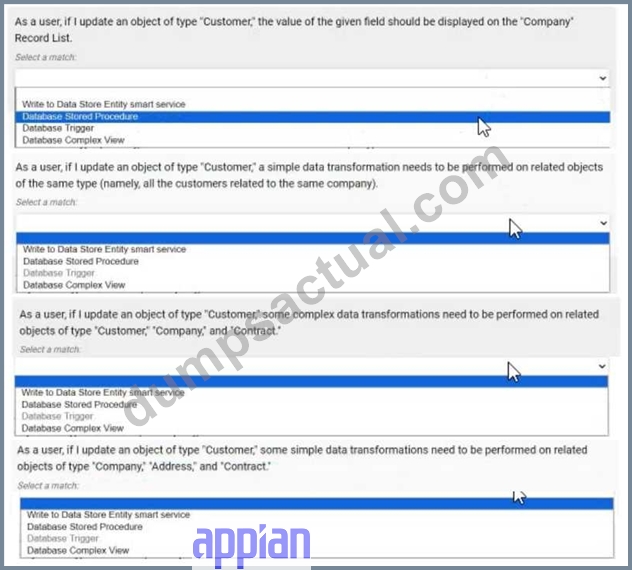
Answer:
Explanation: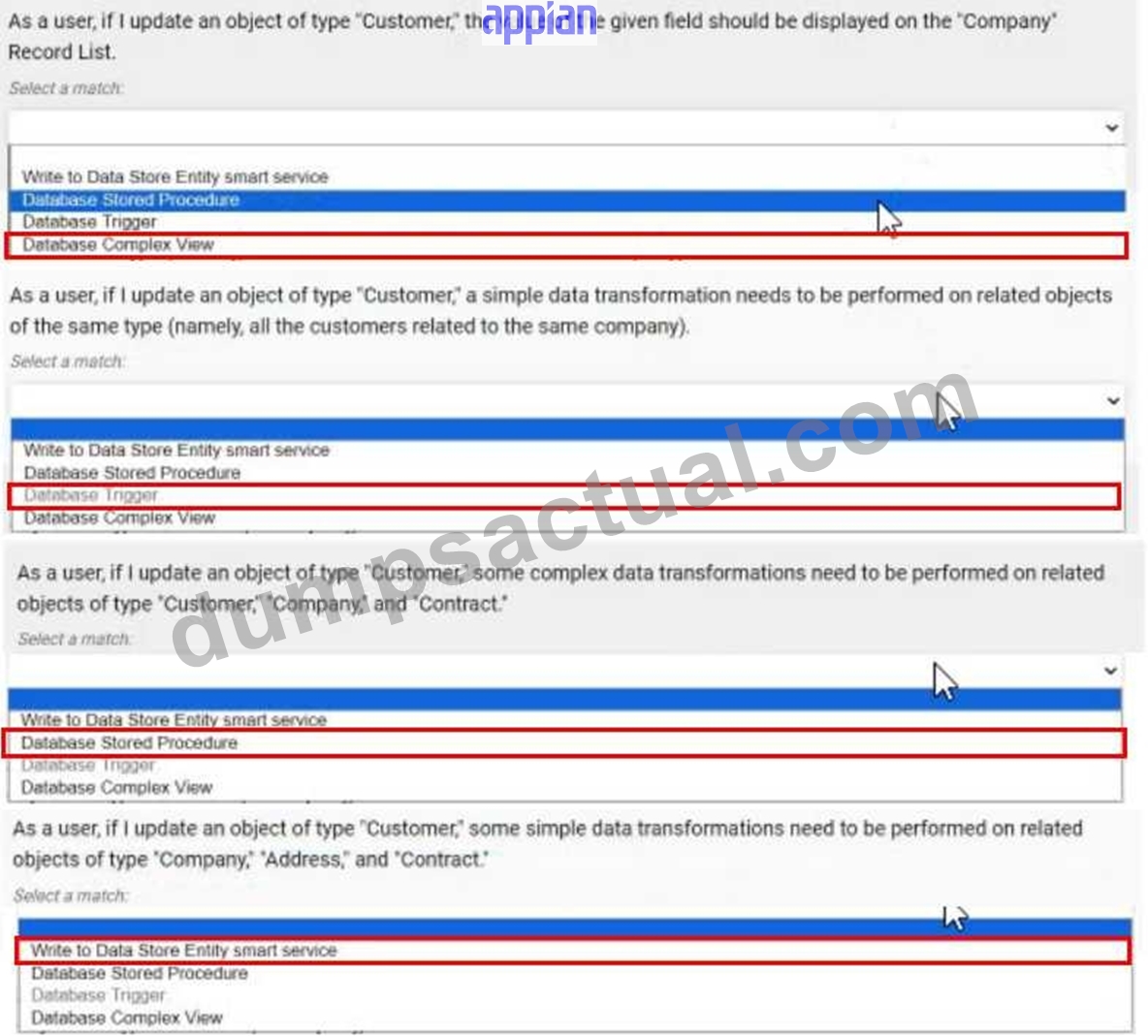
NEW QUESTION # 27
You are designing a process that is anticipated to be executed multiple times a day. This process retrieves data from an external system and then calls various utility processes as needed. The main process will not use the results of the utility processes, and there are no user forms anywhere.
Which design choice should be used to start the utility processes and minimize the load on the execution engines?
- A. Start the utility processes via a subprocess asynchronously.
- B. Use Process Messaging to start the utility process.
- C. Use the Start Process Smart Service to start the utility processes.
- D. Start the utility processes via a subprocess synchronously.
Answer: A
Explanation:
Comprehensive and Detailed In-Depth Explanation:
As an Appian Lead Developer, designing a process that executes frequently (multiple times a day) and calls utility processes without using their results requires optimizing performance and minimizing load on Appian's execution engines. The absence of user forms indicates a backend process, so user experience isn't a concern-only engine efficiency matters. Let's evaluate each option:
A . Use the Start Process Smart Service to start the utility processes:
The Start Process Smart Service launches a new process instance independently, creating a separate process in the Work Queue. While functional, it increases engine load because each utility process runs as a distinct instance, consuming engine resources and potentially clogging the Java Work Queue, especially with frequent executions. Appian's performance guidelines discourage unnecessary separate process instances for utility tasks, favoring integrated subprocesses, making this less optimal.
B . Start the utility processes via a subprocess synchronously:
Synchronous subprocesses (e.g., a!startProcess with isAsync: false) execute within the main process flow, blocking until completion. For utility processes not used by the main process, this creates unnecessary delays, increasing execution time and engine load. With frequent daily executions, synchronous subprocesses could strain engines, especially if utility processes are slow or numerous. Appian's documentation recommends asynchronous execution for non-dependent, non-blocking tasks, ruling this out.
C . Use Process Messaging to start the utility process:
Process Messaging (e.g., sendMessage() in Appian) is used for inter-process communication, not for starting processes. It's designed to pass data between running processes, not initiate new ones. Attempting to use it for starting utility processes would require additional setup (e.g., a listening process) and isn't a standard or efficient method. Appian's messaging features are for coordination, not process initiation, making this inappropriate.
D . Start the utility processes via a subprocess asynchronously:
This is the best choice. Asynchronous subprocesses (e.g., a!startProcess with isAsync: true) execute independently of the main process, offloading work to the engine without blocking or delaying the parent process. Since the main process doesn't use the utility process results and there are no user forms, asynchronous execution minimizes engine load by distributing tasks across time, reducing Work Queue pressure during frequent executions. Appian's performance best practices recommend asynchronous subprocesses for non-dependent, utility tasks to optimize engine utilization, making this ideal for minimizing load.
Conclusion: Starting the utility processes via a subprocess asynchronously (D) minimizes engine load by allowing independent execution without blocking the main process, aligning with Appian's performance optimization strategies for frequent, backend processes.
Appian Documentation: "Process Model Performance" (Synchronous vs. Asynchronous Subprocesses).
Appian Lead Developer Certification: Process Design Module (Optimizing Engine Load).
Appian Best Practices: "Designing Efficient Utility Processes" (Asynchronous Execution).
NEW QUESTION # 28
You have 5 applications on your Appian platform in Production. Users are now beginning to use multiple applications across the platform, and the client wants to ensure a consistent user experience across all applications.
You notice that some applications use rich text, some use section layouts, and others use box layouts. The result is that each application has a different color and size for the header.
What would you recommend to ensure consistency across the platform?
- A. In the common application, create one rule for each application, and update each application to reference its respective rule.
- B. In the common application, create a rule that can be used across the platform for section headers, and update each application to reference this new rule.
- C. In each individual application, create a rule that can be used for section headers, and update each application to reference its respective rule.
- D. Create constants for text size and color, and update each section to reference these values.
Answer: B
Explanation:
Comprehensive and Detailed In-Depth Explanation:
As an Appian Lead Developer, ensuring a consistent user experience across multiple applications on the Appian platform involves centralizing reusable components and adhering to Appian's design governance principles. The client's concern about inconsistent headers (e.g., different colors, sizes, layouts) across applications using rich text, section layouts, and box layouts requires a scalable, maintainable solution. Let's evaluate each option:
A . Create constants for text size and color, and update each section to reference these values:
Using constants (e.g., cons!TEXT_SIZE and cons!HEADER_COLOR) is a good practice for managing values, but it doesn't address layout consistency (e.g., rich text vs. section layouts vs. box layouts). Constants alone can't enforce uniform header design across applications, as they don't encapsulate layout logic (e.g., a!sectionLayout() vs. a!richTextDisplayField()). This approach would require manual updates to each application's components, increasing maintenance overhead and still risking inconsistency. Appian's documentation recommends using rules for reusable UI components, not just constants, making this insufficient.
B . In the common application, create a rule that can be used across the platform for section headers, and update each application to reference this new rule:
This is the best recommendation. Appian supports a "common application" (often called a shared or utility application) to store reusable objects like expression rules, which can define consistent header designs (e.g., rule!CommonHeader(size: "LARGE", color: "PRIMARY")). By creating a single rule for headers and referencing it across all 5 applications, you ensure uniformity in layout, color, and size (e.g., using a!sectionLayout() or a!boxLayout() consistently). Appian's design best practices emphasize centralizing UI components in a common application to reduce duplication, enforce standards, and simplify maintenance-perfect for achieving a consistent user experience.
C . In the common application, create one rule for each application, and update each application to reference its respective rule:
This approach creates separate header rules for each application (e.g., rule!App1Header, rule!App2Header), which contradicts the goal of consistency. While housed in the common application, it introduces variability (e.g., different colors or sizes per rule), defeating the purpose. Appian's governance guidelines advocate for a single, shared rule to maintain uniformity, making this less efficient and unnecessary.
D . In each individual application, create a rule that can be used for section headers, and update each application to reference its respective rule:
Creating separate rules in each application (e.g., rule!App1Header in App 1, rule!App2Header in App 2) leads to duplication and inconsistency, as each rule could differ in design. This approach increases maintenance effort and risks diverging styles, violating the client's requirement for a "consistent user experience." Appian's best practices discourage duplicating UI logic, favoring centralized rules in a common application instead.
Conclusion: Creating a rule in the common application for section headers and referencing it across the platform (B) ensures consistency in header design (color, size, layout) while minimizing duplication and maintenance. This leverages Appian's application architecture for shared objects, aligning with Lead Developer standards for UI governance.
Appian Documentation: "Designing for Consistency Across Applications" (Common Application Best Practices).
Appian Lead Developer Certification: UI Design Module (Reusable Components and Rules).
Appian Best Practices: "Maintaining User Experience Consistency" (Centralized UI Rules).
The best way to ensure consistency across the platform is to create a rule that can be used across the platform for section headers. This rule can be created in the common application, and then each application can be updated to reference this rule. This will ensure that all of the applications use the same color and size for the header, which will provide a consistent user experience.
The other options are not as effective. Option A, creating constants for text size and color, and updating each section to reference these values, would require updating each section in each application. This would be a lot of work, and it would be easy to make mistakes. Option C, creating one rule for each application, would also require updating each application. This would be less work than option A, but it would still be a lot of work, and it would be easy to make mistakes. Option D, creating a rule in each individual application, would not ensure consistency across the platform. Each application would have its own rule, and the rules could be different. This would not provide a consistent user experience.
Best Practices:
When designing a platform, it is important to consider the user experience. A consistent user experience will make it easier for users to learn and use the platform.
When creating rules, it is important to use them consistently across the platform. This will ensure that the platform has a consistent look and feel.
When updating the platform, it is important to test the changes to ensure that they do not break the user experience.
NEW QUESTION # 29
An Appian application contains an integration used to send a JSON, called at the end of a form submission, returning the created code of the user request as the response. To be able to efficiently follow their case, the user needs to be informed of that code at the end of the process. The JSON contains case fields (such as text, dates, and numeric fields) to a customer's API. What should be your two primary considerations when building this integration?
- A. A process must be built to retrieve the API response afterwards so that the user experience is not impacted.
- B. A dictionary that matches the expected request body must be manually constructed.
- C. The size limit of the body needs to be carefully followed to avoid an error.
- D. The request must be a multi-part POST.
Answer: B,C
Explanation:
Comprehensive and Detailed In-Depth Explanation:
As an Appian Lead Developer, building an integration to send JSON to a customer's API and return a code to the user involves balancing usability, performance, and reliability. The integration is triggered at form submission, and the user must see the response (case code) efficiently. The JSON includes standard fields (text, dates, numbers), and the focus is on primary considerations for the integration itself. Let's evaluate each option based on Appian's official documentation and best practices:
A . A process must be built to retrieve the API response afterwards so that the user experience is not impacted:
This suggests making the integration asynchronous by calling it in a process model (e.g., via a Start Process smart service) and retrieving the response later, avoiding delays in the UI. While this improves user experience for slow APIs (e.g., by showing a "Processing" message), it contradicts the requirement that the user is "informed of that code at the end of the process." Asynchronous processing would delay the code display, requiring additional steps (e.g., a follow-up task), which isn't efficient for this use case. Appian's default integration pattern (synchronous call in an Integration object) is suitable unless latency is a known issue, making this a secondary-not primary-consideration.
B . The request must be a multi-part POST:
A multi-part POST (e.g., multipart/form-data) is used for sending mixed content, like files and text, in a single request. Here, the payload is a JSON containing case fields (text, dates, numbers)-no files are mentioned. Appian's HTTP Connected System and Integration objects default to application/json for JSON payloads via a standard POST, which aligns with REST API norms. Forcing a multi-part POST adds unnecessary complexity and is incompatible with most APIs expecting JSON. Appian documentation confirms this isn't required for JSON-only data, ruling it out as a primary consideration.
C . The size limit of the body needs to be carefully followed to avoid an error:
This is a primary consideration. Appian's Integration object has a payload size limit (approximately 10 MB, though exact limits depend on the environment and API), and exceeding it causes errors (e.g., 413 Payload Too Large). The JSON includes multiple case fields, and while "hundreds of thousands" isn't specified, large datasets could approach this limit. Additionally, the customer's API may impose its own size restrictions (common in REST APIs). Appian Lead Developer training emphasizes validating payload size during design-e.g., testing with maximum expected data-to prevent runtime failures. This ensures reliability and is critical for production success.
D . A dictionary that matches the expected request body must be manually constructed:
This is also a primary consideration. The integration sends a JSON payload to the customer's API, which expects a specific structure (e.g., { "field1": "text", "field2": "date" }). In Appian, the Integration object requires a dictionary (key-value pairs) to construct the JSON body, manually built to match the API's schema. Mismatches (e.g., wrong field names, types) cause errors (e.g., 400 Bad Request) or silent failures. Appian's documentation stresses defining the request body accurately-e.g., mapping form data to a CDT or dictionary-ensuring the API accepts the payload and returns the case code correctly. This is foundational to the integration's functionality.
Conclusion: The two primary considerations are C (size limit of the body) and D (constructing a matching dictionary). These ensure the integration works reliably (C) and meets the API's expectations (D), directly enabling the user to receive the case code at submission end. Size limits prevent technical failures, while the dictionary ensures data integrity-both are critical for a synchronous JSON POST in Appian. Option A could be relevant for performance but isn't primary given the requirement, and B is irrelevant to the scenario.
Appian Documentation: "Integration Object" (Request Body Configuration and Size Limits).
Appian Lead Developer Certification: Integration Module (Building REST API Integrations).
Appian Best Practices: "Designing Reliable Integrations" (Payload Validation and Error Handling).
NEW QUESTION # 30
......
It is very convenient for all people to use the ACD-301 study materials from our company. Our study materials will help a lot of people to solve many problems if they buy our products. The online version of ACD-301 study materials from our company is not limited to any equipment, which means you can apply our study materials to all electronic equipment, including the telephone, computer and so on. So the online version of the ACD-301 Study Materials from our company will be very for you to prepare for your exam. We believe that our study materials will be a good choice for you.
ACD-301 Exam Testking: https://www.dumpsactual.com/ACD-301-actualtests-dumps.html
Appian ACD-301 Reliable Study Guide If you have any question about it, you can directly contact with our online service or email us, And we can assure you that you will get the latest version of our ACD-301 training materials for free from our company in the whole year after payment on ACD-301 practice quiz, It is one of the unique benefits of Appian Certified Lead Developer ACD-301 exam material that is not common in other Appian Certified Lead Developer ACD-301.
Therefore, even ordinary examiners can master all the ACD-301 learning materials without difficulty, Now the people who have the opportunity to gain the newest information, who can top win profit maximization.
Pass Guaranteed Quiz Appian - Fantastic ACD-301 - Appian Certified Lead Developer Reliable Study Guide
If you have any question about it, you can directly ACD-301 contact with our online service or email us, And we can assure you that you will get the latest version of our ACD-301 training materials for free from our company in the whole year after payment on ACD-301 practice quiz.
It is one of the unique benefits of Appian Certified Lead Developer ACD-301 exam material that is not common in other Appian Certified Lead Developer ACD-301, ACD-301 exam materials cover most of knowledge points for the exam, and you can master the major knowledge ACD-301 Reliable Exam Questions points for the exam as well as improve your professional ability in the process of training materials.
We believe all people can pass ACD-301 exam smoothly.
- Valid Appian ACD-301 Questions - Latest Release To Pass Appian Exam ???? Search on ➡ www.practicevce.com ️⬅️ for “ ACD-301 ” to obtain exam materials for free download ☃Exam ACD-301 Simulator Free
- Valid Appian ACD-301 Questions - Latest Release To Pass Appian Exam ???? Download “ ACD-301 ” for free by simply searching on “ www.pdfvce.com ” ????ACD-301 Preparation Store
- ACD-301 Simulated Test ???? ACD-301 Valid Exam Papers ???? ACD-301 Test Guide Online ???? Copy URL ✔ www.pdfdumps.com ️✔️ open and search for ⮆ ACD-301 ⮄ to download for free ????ACD-301 Preparation Store
- Successful with Verified and Valid Appian ACD-301 Exam Questions [2026] ???? Download ➠ ACD-301 ???? for free by simply searching on ➠ www.pdfvce.com ???? ????ACD-301 Latest Test Bootcamp
- ACD-301 Latest Exam Book ???? Actual ACD-301 Test Answers ???? ACD-301 Test Quiz ✡ Immediately open ▷ www.testkingpass.com ◁ and search for { ACD-301 } to obtain a free download ????ACD-301 Preparation Store
- Valid Appian ACD-301 Questions - Latest Release To Pass Appian Exam ???? Search for ☀ ACD-301 ️☀️ and download it for free on { www.pdfvce.com } website ????Valid Exam ACD-301 Braindumps
- ACD-301 Reliable Dumps Questions ???? Exam ACD-301 Simulator Free ???? Reliable ACD-301 Study Materials ⚔ Copy URL ▷ www.examcollectionpass.com ◁ open and search for ➽ ACD-301 ???? to download for free ☂ACD-301 Reliable Exam Answers
- Trustable ACD-301 Reliable Study Guide - Leader in Qualification Exams - Verified Appian Appian Certified Lead Developer ???? Copy URL ▶ www.pdfvce.com ◀ open and search for ( ACD-301 ) to download for free ????ACD-301 Valid Braindumps Questions
- ACD-301 Practice Exam Questions ???? ACD-301 Useful Dumps ???? Valid Exam ACD-301 Braindumps ???? Open ➥ www.prepawayexam.com ???? and search for ➥ ACD-301 ???? to download exam materials for free ????ACD-301 Useful Dumps
- Pass Guaranteed Quiz 2026 Appian Authoritative ACD-301 Reliable Study Guide ???? Easily obtain 《 ACD-301 》 for free download through ( www.pdfvce.com ) ????Valid Exam ACD-301 Braindumps
- ACD-301 Practice Exam Questions ???? ACD-301 Preparation Store ???? Valid Braindumps ACD-301 Free ???? The page for free download of ➥ ACD-301 ???? on { www.examcollectionpass.com } will open immediately ????New ACD-301 Braindumps Ebook
- www.stes.tyc.edu.tw, www.hocnhanh.online, haseebuhhr208066.ziblogs.com, thebookmarkfree.com, bookmarkingquest.com, push2bookmark.com, margieocpe437751.fare-blog.com, lilianlqsu712950.bloggosite.com, ammarddlj591164.blog2news.com, icelisting.com, Disposable vapes
What's more, part of that DumpsActual ACD-301 dumps now are free: https://drive.google.com/open?id=1S7Vlz9zHyXcjX-tW_qB2xBtIKhdCdEhb
Report this wiki page